1. Introduction
International goals are setting the pace as climate urgency increases:
- The UN's 2030 Agenda calls for drastic emissions reductions to keep warming to 1.5°C.
- Near-total decarbonization across sectors is required by the 2050 Net-Zero commitment, which is currently being echoed by more than 140 countries.
Carbon tracking technologies have exploded in response, allowing for digital reporting, audit-ready transparency, and real-time emissions data collection. Corporate sustainability is changing thanks to technologies like blockchain-based carbon registries and AI-powered MRV (Monitoring, Reporting, Verification) systems. Understanding carbon tracking is now essential for companies; it is the cornerstone of compliance, investor confidence, and long-term survival in a low-carbon future.
2. What is Carbon Management?
A method for quantifying, cutting, and disclosing greenhouse gas (GHG) emissions is called carbon management. Consider it a climate "budget" that assists companies in monitoring their carbon emissions and identifying more intelligent methods to reduce them, such as process redesign, energy efficiency, or cleaner technologies.
The primary cause of climate change is GHG emissions. In addition to assisting companies in identifying areas of inefficiency, emissions monitoring opens doors for cost reduction and innovation. Emissions reduction ensures long-term sustainability, improves resilience, and safeguards ecosystems.
Maintaining compliance with changing climate regulations and meeting Environmental, Social, and Governance (ESG) expectations depend heavily on carbon management. Companies are being held more and more responsible for their environmental impact by regulators, investors, and consumers. Businesses that practice effective carbon management signal transparency and long-term sustainability by aligning with frameworks such as the Science-Based Targets initiative (SBTi) or the Task Force on Climate-related Financial Disclosures (TCFD).
3. Carbon Emission Management
Carbon emissions are divided into groups according to where they come from:
- Scope 1: Direct emissions from owned or managed sources, such as company cars or fuel combustion on-site.
- Scope 2: Indirect emissions from steam, heating, cooling, or electricity purchases.
- Scope 3: All additional indirect emissions from the value chain, such as waste, transportation, suppliers, and product use.
To obtain a complete picture of a company's environmental impact, effective carbon management entails addressing all three scopes.
Why Accurate Measurement and Monitoring Matter
What you cannot measure, you cannot reduce.
Accurate monitoring helps companies to
- Establish reasonable, scientific reduction goal
- Determine emission hotspots in supply chains and operations.
- Monitor developments and provide truthful reports.
This is now more feasible than ever thanks to real-time dashboards, AI-driven analytics, and sophisticated digital MRV systems.
Internationally accepted frameworks assist businesses in consistently measuring and reporting:
Standards That Guide Emissions Accounting
- The GHG Protocol: establishes the benchmark for reporting and classifying emissions in all contexts.
- For audit and certification purposes, ISO 14064 offers comprehensive guidelines for measuring, tracking, and confirming GHG emissions.
When combined, these standards increase ESG credibility, facilitate comparability, and foster trust.
4. Carbon Management Solutions
Key Components
Understanding is the first step in carbon management, not reduction. Three essential pillars are needed to transform emissions data into workable decarbonization strategies for industries aiming for net-zero, particularly in hard-to-abate sectors:
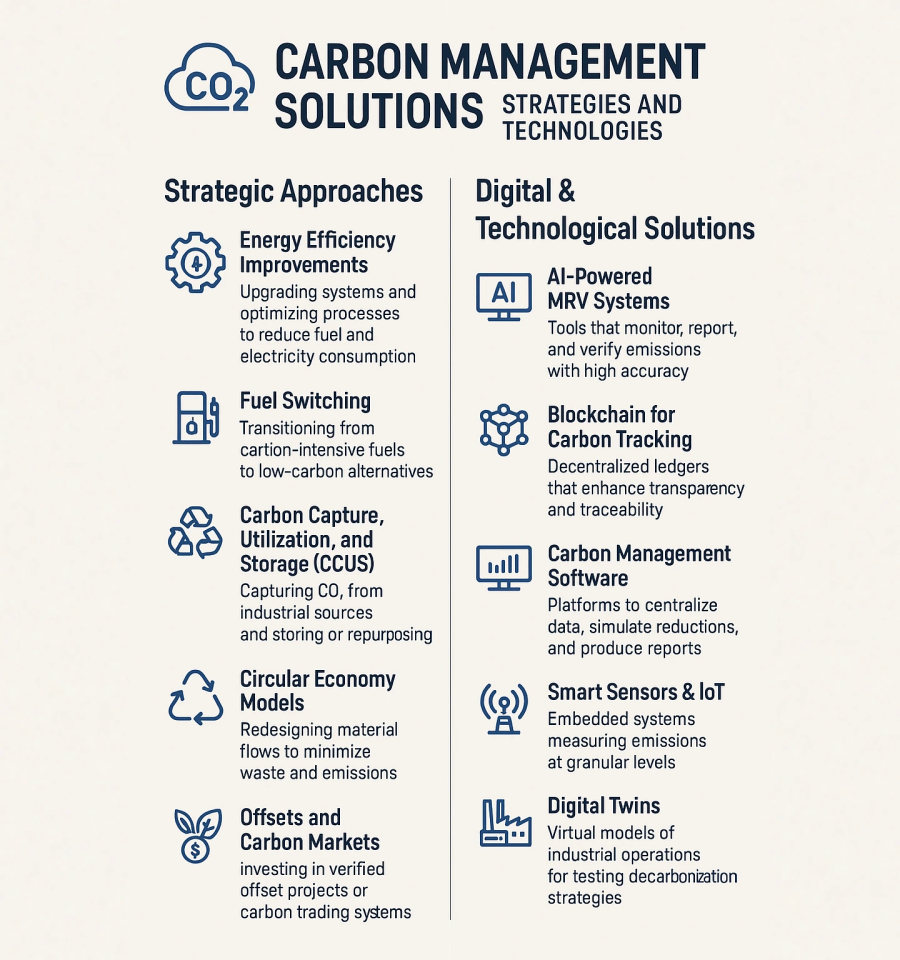
- Data collection & baseline
- Analytics & reporting, and
- Predictive modeling & reduction planning
1. Data Collection & Baselining
- Gather activity-level emissions data across Scope 1, 2, and 3. Deploy IoT sensors for real-time, site-level monitoring.
- Establish historical baselines aligned with regulatory frameworks like UAE's Climate Decree 2024.
- Why it matters:: Accurate baselining ensures reliable target-setting and compliance.
2. Emission Analytics & Reporting
- Use AI-powered MRV systems to automate monitoring and verification. Centralize data via carbon accounting platforms (e.g. SustainOS).
- Apply GHG Protocol or ISO standards for audit-ready reporting.
- Build dashboards for stakeholder communication and ESG disclosure.
- Why it matters:: Analytics translate raw data into actionable insights, building trust and transparency.
3. Predictive Modeling & Reduction Planning
- Simulate decarbonization options with digital twins. Forecast emission trends using ML algorithms.
- Apply abatement curve analysis to prioritize low-cost, high-impact interventions.
- Design reduction strategies tailored to production processes.
- Why it matters:: Predictive modeling turns insights into strategic decisions and measurable outcomes.
5. Carbon Management Software & Platforms
🧩 What Is Carbon Management Software?
The term "carbon management software" describes specialized platforms that assist businesses in measuring, tracking, and lowering greenhouse gas emissions throughout their operations. The intricate process of figuring out carbon footprints for Scope 1 (direct), Scope 2 (indirect energy), and Scope 3 (supply chain) emissions is automated by these tools. They act as the foundation of the digital system for:
- Carbon accounting
- Adherence to regulations
- Reporting on sustainability
- Planning for strategic decarbonization
⚙️ Key Features of a Carbon Management Platform
Spreadsheets and static reports are no longer the only platforms available today. They provide:
- Real-Time Emissions Tracking: Live data feeds are provided by IoT sensors and energy system integrations.
- Automated Carbon Calculations: Raw activity data is transformed into emissions metrics using AI and ML algorithms.
- Scope 1, 2, and 3 Coverage: Extensive monitoring of value chain, direct, and indirect emissions.
- Scenario Modeling & Forecasting: The process of modeling and forecasting future emissions under various operational or policy conditions is known as scenario modeling.
- Audit-Ready Reporting: Produce disclosures that comply with SEC regulations, ISO 14064, CSRD, and the GHG Protocol.
- Stakeholder dashboards: Showcase performance to investors, regulators, and internal teams.
SustainOS by Net Carbon Vision
SustainOS is an AI-powered carbon management platform designed for hard-to-abate industries like metals, cement, and fossil fuels. It was created by UAE-based Net Carbon Vision. Among the key capabilities are: -
- Digital Twin Integration: Virtually test decarbonization strategies and simulate plant operations.
- Real Time Tracking: Track Scope 1, 2, and 3 emissions in supply chains and facilities with real-time asset-level insights.
- Predictive analytics: Use AI/ML to pinpoint emission hotspots and their underlying causes.
- Compliance Alignment: Complies with UAE's Climate Decree 2024, ISO 14001, and CSRD frameworks.
- Carbon Credit & Offset Management: Simplifies reporting and transactions for confirmed offsets.
📈 Digital vs. Manual Tracking: Why It Matters
|
| Accuracy | Prone to human error | AI-enhanced precision |
| Speed | Time-consuming data entry | Real-time monitoring |
| Scalability | Difficult across large operations | Easily integrates across sites & systems |
| Compliance | Risk of non-alignment | Auto-aligned with global standards |
| Insights | Limited analysis | Predictive modeling & scenario planning |
| Transparency | Hard to audit | Audit-ready dashboards & disclosures |
Digital platforms not only reduce emissions-they reduce risk, cost, and complexity. They empower sustainability teams to move from reactive reporting to proactive strategy.
6. Carbon Reduction Management Strategies
|
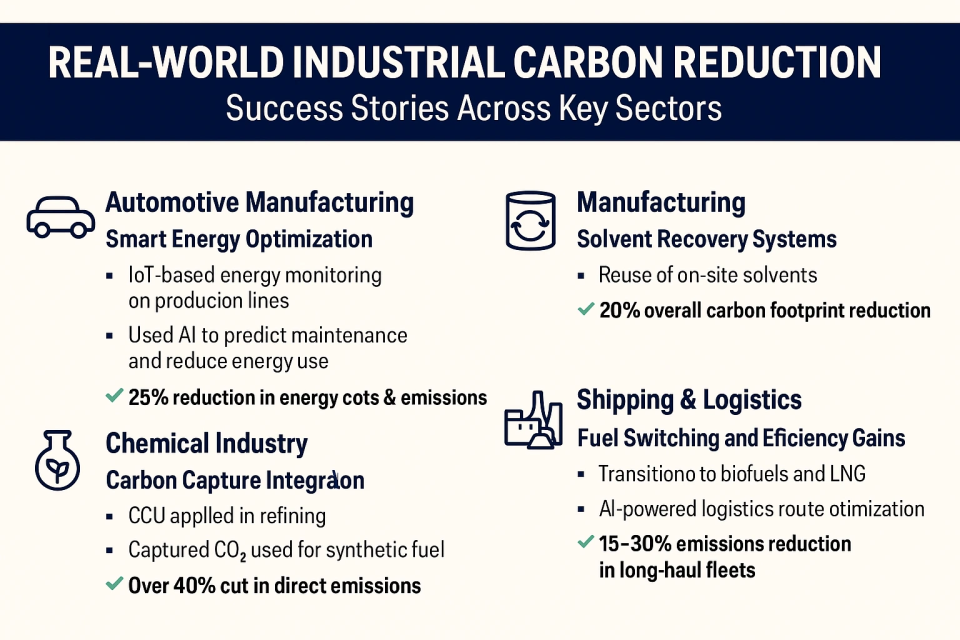
| ⚙️ Process Optimization & Energy Efficiency | - Upgrade machinery - Recover waste heat - Use predictive analytics for scheduling | 🔹 15–20% emissions cut in energy-intensive sectors |
| 🔋 Renewable Energy & Green Hydrogen | - Install solar/wind - Use green hydrogen for high-heat - Co-locate energy and hydrogen systems | 🔹 Near-zero emissions in power and fuel applications |
| 🧪 Carbon Capture, Utilization & Storage | - Post-/oxy-combustion capture - CO₂ reuse/storage - Deploy mobile CCUS units | 🔹 Up to 90% reduction in point-source CO₂ emissions |
| 🔄 Circular Economy Practices | - Reuse process inputs - Recycle CO₂ into products - Apply 10R framework | 🔹 Cuts emissions via resource reuse and waste reduction |
| 🤖 AI & Digital Twins | - Simulate operations - Forecast emissions - Automate ESG and energy optimization | 🔹 Boosts precision, efficiency, and compliance |
7. Carbon Management Consulting
🌍 Why Businesses Need Expert Consulting
Expert advice helps businesses that are struggling with sustainability and compliance in the following ways:
- Navigate Complex Regulations: Consultants interpret environmental laws and standards, such as the GHG Protocol.
- Create Decarbonization Strategies: They create concise, doable plans that are in line with industry objectives.
- Optimize Efficiency: Expert consulting speeds up development and prevents expensive blunders.
🏭 Why Specialists Matter for Complex Industries
Generic solutions are inadequate in high-emission industries such as steel, cement, and oil and gas.
- Sector-Specific Expertise:Strategies grounded in industry realities are what specialists provide.
- Advanced Technology Integration:Expertise in process redesign, alternative fuels, and carbon capture.
- Credible Validation:Stakeholder and investor trust is increased by independent data.
8. Benefits of Carbon Management
A strategic business advantage, effective carbon management goes beyond simply achieving sustainability objectives. Here's how it has a significant impact in a number of areas:
1. Regulatory Compliance
Comply with climate reporting guidelines like
- CDP:Make sure that investor-grade climate data is disclosed accurately.
- CSRD:Comply with double materiality assessments and EU sustainability directives.
- GHG Protocols:Use international best practices to quantify emissions across Scopes 1, 2, and 3.
2. Cost savings from energy optimization
Carbon audits help identify:
- Energy waste across operations.
- Upgrade opportunities (e.g., efficient lighting, HVAC, renewable integration).
- Lower utility costs with optimized performance.
Better energy use means lower overhead.
3. Improved brand reputation and investor confidence
A strong carbon strategy boosts:
- Consumer trust through transparent reporting.
- Investor confidence with clear ESG metrics.
- Reputation value in competitive markets.
Sustainability strengthens stakeholder relationships.
4. Monetizing emission reductions via carbon credits
Emission reductions can be monetized through:
- Voluntary carbon markets.
- Compliance trading schemes.
- Offsetting programs to support net-zero goals.
Carbon becomes a financial asset-not just a liability.
9. Future of Carbon Management
With the emergence of AI-powered platforms that offer real-time tracking, predictive modeling, and compliance automation, carbon management is changing quickly. Digital twins, machine learning, and emissions analytics are all combined in solutions like SustainOS to model decarbonization scenarios, identify inefficiencies, and comply with international standards like the UAE's Climate Decree 2024 and the CSRD. This change turns carbon management from a reporting exercise into a strategic instrument that aids in operational planning and investment choices.
The way industries handle climate accountability is changing as a result of emerging trends like virtual simulations, automated MRV frameworks, and blockchain-enabled carbon credit systems. Strong carbon management is the cornerstone of quantifiable impact, stakeholder trust, and competitive advantage in a low-carbon economy as the energy transition accelerates from fossil fuels to renewables and green hydrogen.
10. Conclusion
Effective carbon emission management isn't just a regulatory requirement-it's a strategic imperative for industries navigating climate accountability and Net Zero goals. By proactively monitoring and mitigating emissions, companies build resilience, operational efficiency, and trust across stakeholders and supply chains.
Partnering with Net Carbon Vision ensures that this journey is guided by deep technical expertise and advanced software tools tailored to your sector. Whether you're optimizing decarbonization pathways or deploying real-time tracking systems, Net Carbon Vision bridges the gap between compliance and climate leadership.