1. Introduction
For companies looking to fulfill their environmental responsibilities and maintain their competitiveness, measuring and lowering carbon footprints is essential. Transparent emissions reporting is required by regulatory frameworks, such as the UAE's 2024 Climate Decree. Businesses can identify operational inefficiencies, enhance ESG performance, and align with net-zero targets with the help of accurate footprint data. Additionally, it guarantees access to climate-conscious markets and enhances brand reputation.
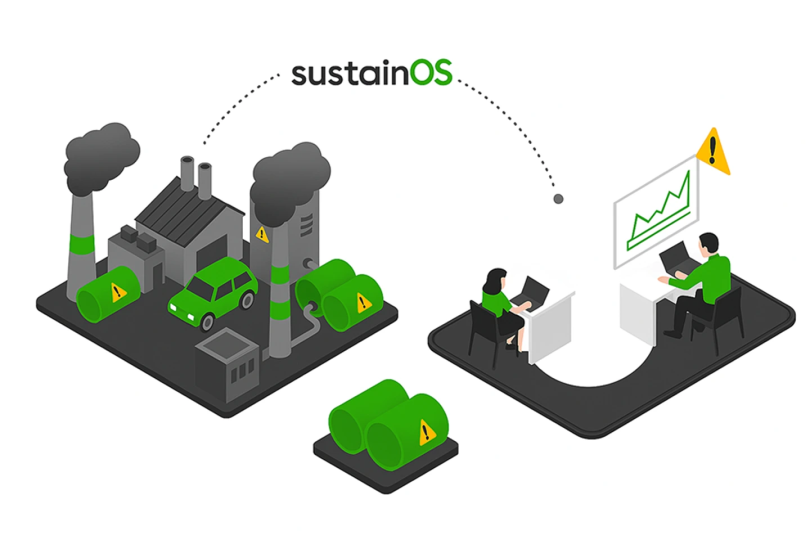
NCV's SustainOS platform provides real-time carbon footprint monitoring and reduction tools to help with this. SustainOS assists companies in transforming emissions data into strategic action through automated tracking, AI-driven insights, and customizable reporting.
Scope 1, 2, and 3 Emissions: GHG Protocol Framework
|
| Scope 1 | Direct GHG emissions from sources owned or controlled by the organization | On-site fuel combustion Company vehicles Industrial processes | Fully under organizational control |
| Scope 2 | Indirect GHG emissions from the generation of purchased energy | Electricity Steam Heating Cooling purchased from external providers | Shared with energy suppliers |
| Scope 3 | All other indirect emissions occurring in the value chain | Purchased goods and services Transportation Waste Employee travel Product use | Shared across suppliers, customers, and partners |
2. Utilize Emission Factors to Convert
Activity data is converted into greenhouse gas emissions by emission factors. The amount of GHG released per unit of activity is represented by these factors, which are frequently supplied by official databases (e.g., kg CO₂ per kWh of electricity). To obtain emissions in CO₂e for a given category, multiply each activity figure by the corresponding emission factor.
Formula: Emissions = Activity Data X Emission Factor
Example: If a company uses 10,000 kWh of electricity and the emission factor is 0.233 kg CO₂e/kWh: → Emissions = 10,000 X 0.233 = 2,330 kg CO₂e
3. Sum to Get Total CO₂e
Different greenhouse gases (CO₂, CH₄, N₂O) have varying global warming potentials (GWPs). To compare them, convert all emissions to CO₂ equivalent (CO₂e) using GWP multipliers.
CO₂e = CO₂ + (CH₄ X GWP_CH₄) + (N₂O X GWP_N₂O)
Final Output: A total CO₂e figure that reflects your organization's climate impact-ready for dashboards, reports, and reduction planning.
Why It Matters
This method forms the backbone of credible sustainability reporting, enabling:
- Compliance with frameworks like GHG Protocol, CDP, and Net Zero 2050.
- Identification of high-impact areas for decarbonization.
- Transparent communication with stakeholders and regulators.
4. What Are the Main Sources of Carbon Pollution?
A variety of industries and activities contribute to carbon pollution, which is expressed in CO₂-equivalent (CO₂e). Targeted decarbonization requires an understanding of these sources.
🏭 Key Contributors to Carbon Emissions
- Combustion of Fossil Fuels:The main cause of CO2 emissions worldwide is the burning of coal, oil, and natural gas for heat and energy. Frequently found in transport engines, industrial boilers, and power plants.
- Production of Electricity:Scope 2 emissions are largely caused by grid electricity, particularly that which comes from fossil fuels. Emissions differ depending on the energy mix, including fossil fuels and renewables.
- Transportation:Petroleum-based fuels are essential to air, sea, and road transportation. Personal vehicles, freight, aviation, and logistics are all included.
- Industrial Production:Steel, cement, chemicals, and manufacturing are among the industries with high emissions. Emissions are caused by both process-related GHGs and energy use.
📦 Product-Level Emissions: The Life-Cycle Perspective
Emissions from a product's whole life cycle are included in its carbon footprint:
- Extraction of Raw Materials: Mining, farming, and deforestation.
- Energy-intensive procedures in manufacturing and assembly.
- Distribution and Use: Transportation, energy consumption by consumers.
- End-of-Life: Effects on landfills, recycling, or disposal.
- Product design and sustainability labeling require this cradle-to-grave methodology.
⚠️ High-Emission Products & Sectors
Some products and industries have disproportionately high carbon footprints:
|
| Meat (esp. beef) | Methane from livestock Land use change Feed production |
| Electronics | Energy-intensive manufacturing Rare earth mining Short lifespans |
| Cement & Concrete | CO₂ released during limestone calcination Fuel combustion |
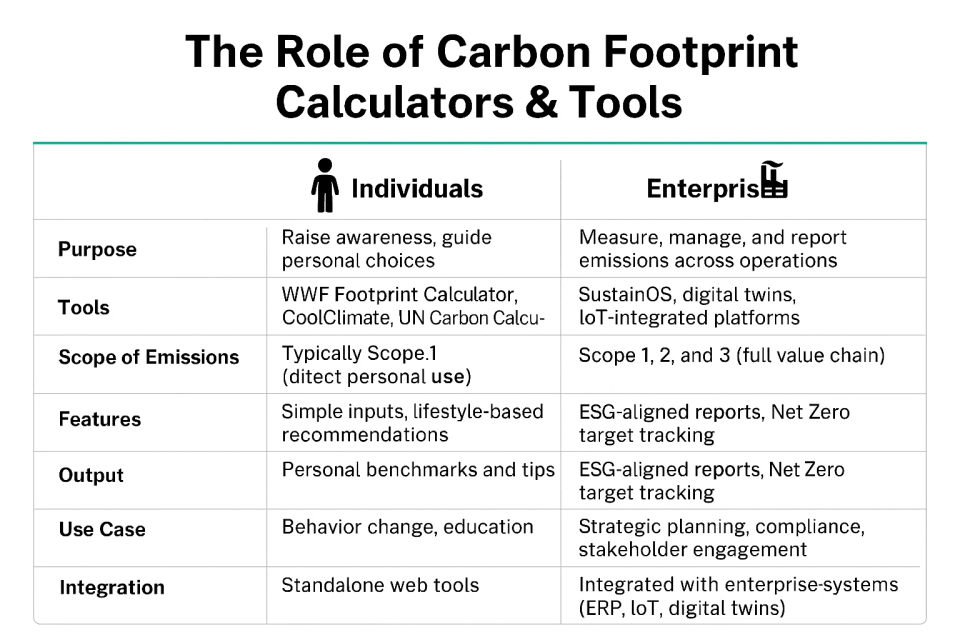
Raising awareness of Scope 1 emissions
They are perfect for encouraging changes in behavior and environmentally friendly choices.
🏭 For Enterprises: Precision, Strategy & Compliance
Beyond estimates, industrial decarbonization necessitates strong platforms that facilitate transparent reporting, strategic planning, and real-time tracking. One notable enterprise-grade solution is SustainOS:
- Complete measurement of Scope 1, 2, and 3 emissions.
- Scenario modeling and predictive analytics.
- Net Zero alignment and automated ESG reporting.
- Integration with ERP, IoT, and digital twins.
These capabilities enable industries to confidently communicate progress, optimize operations, and comply with climate mandates.
Carbon tools serve as the link between data and climate action, whether you're managing emissions throughout a convoluted supply chain or calculating your personal footprint. That bridge is scalable, strategic, and prepared for the future thanks to SustainOS and NCV's experience.
7. Conclusion
For UAE industries to meet sustainability targets, maintain regulatory compliance, and remain globally competitive in the race to Net Zero 2050, it is imperative that carbon footprints be understood, measured, and reduced. Transparent ESG reporting, data-driven decision-making, and operational efficiency are all made possible by accurate emissions tracking. Businesses can simulate reduction pathways, streamline carbon management, and align with national climate strategies by utilizing platforms such as SustainOS and NCV's expertise in industrial decarbonization, paired with SustainOS's digital capabilities, offers UAE manufacturers a scalable, compliant, and future-ready solution. From emissions mapping to stakeholder reporting, these tools simplify complexity and drive results.